
Knowledge Bank
Space West Informational Series
• What is NewSpace, actually?
• Why is it not happening in Sweden?
• What changes are needed for it to finally get going in Sweden?
The Space West Informational Series provides essential insights, intended to address the questions above in a relevant and meaningful way.
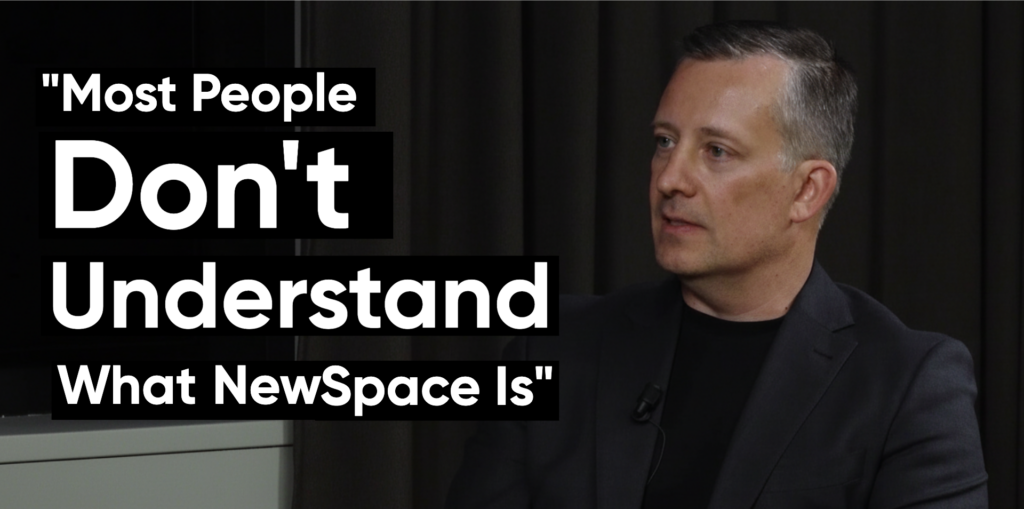
Chapter 1:
OLD vs. NEW
The procurement of
products vs. services
Published: 2025-11-20
Chapter 2: THE CRITICALITY OF END-TO-END SERVICES
For commercial success and national sovereignty
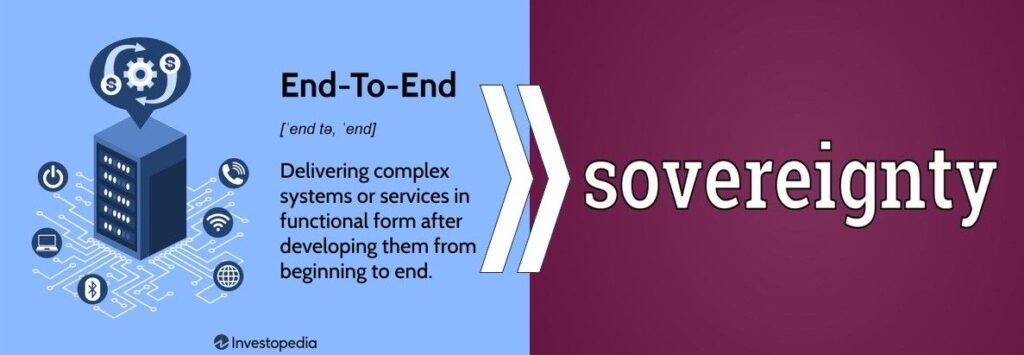
Published: 2025-11-24
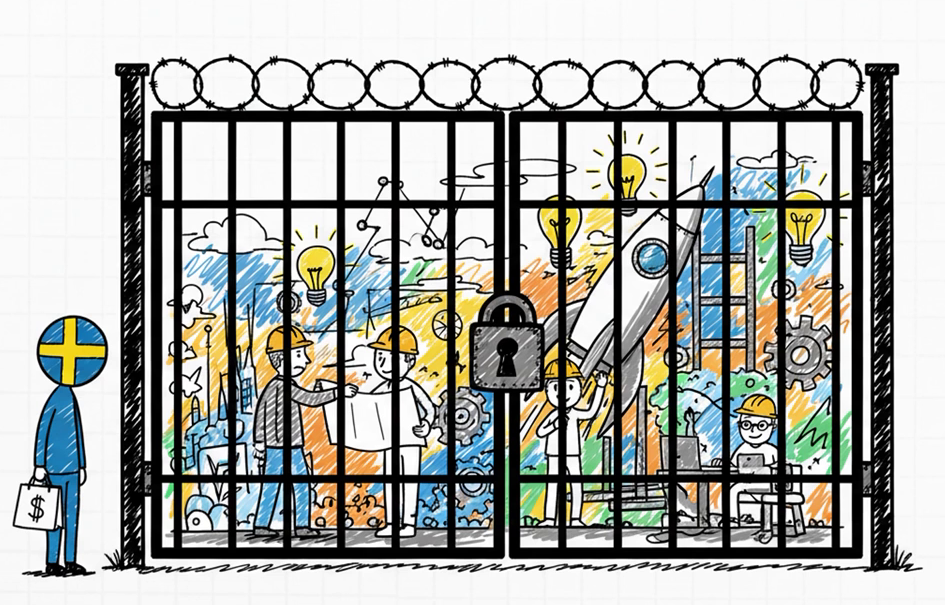
Chapter 3:
A CROSSROADS DECISION
Become a supplier or
remain a consumer?
Published: 2025-11-30
Chapter 4: UNDERSTANDING HISTORY
What enabled the first NewSpace companies to develop?

Published: 2025-12-08
Chapter 5:
SWEDEN’S CURRENT PROCUREMENT SYSTEM
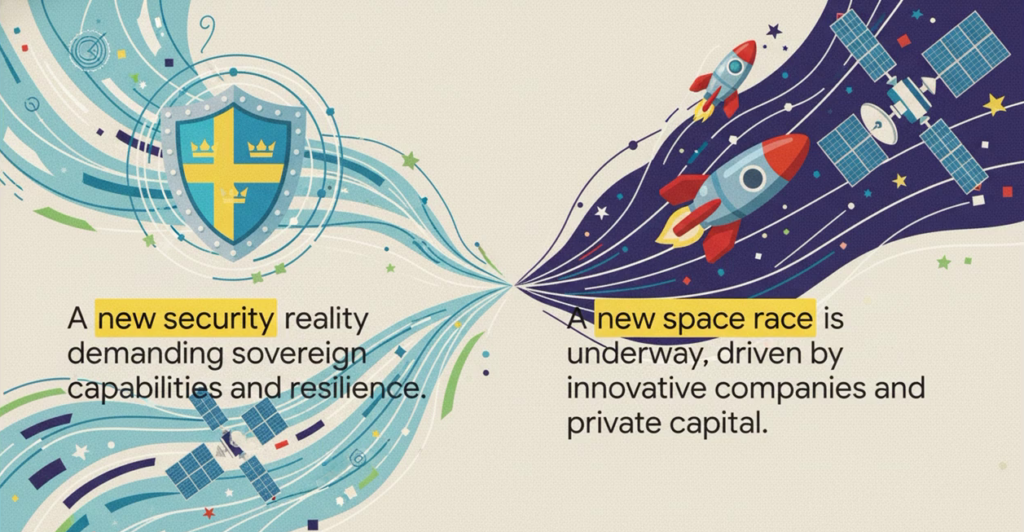
Is preventing the NewSpace recipe from being applied
Published: 2025-12-16
Chapter 6:
WHAT CAN SWEDEN DO?
To achieve sovereign capabilities and long-term success
Published: 2026-01-08
Chapter 7: CONCLUSIONS
…and recommendations
Additional Reading
In the current geopolitical climate, Sweden faces a critical vulnerability by relying heavily on foreign providers for satellite data that’s essential for national defense. As illustrated by recent events in Ukraine, a nation that lacks independent access to vital space capabilities will find itself in a situation of dependency.
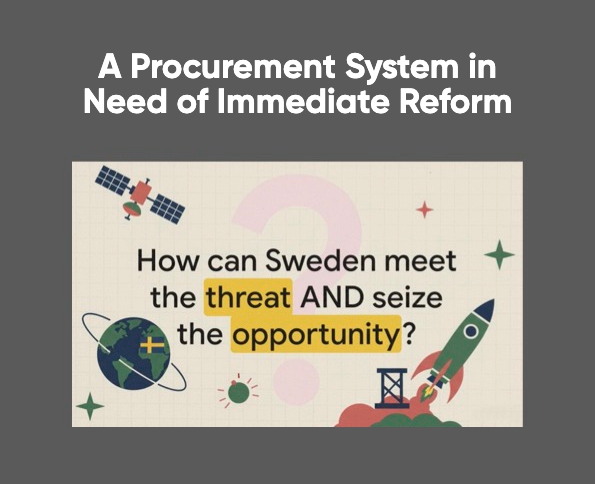
Sweden’s National Security Depends on Procurement Speed
– We must change.
Video
Sweden’s Future in Space is on the line.
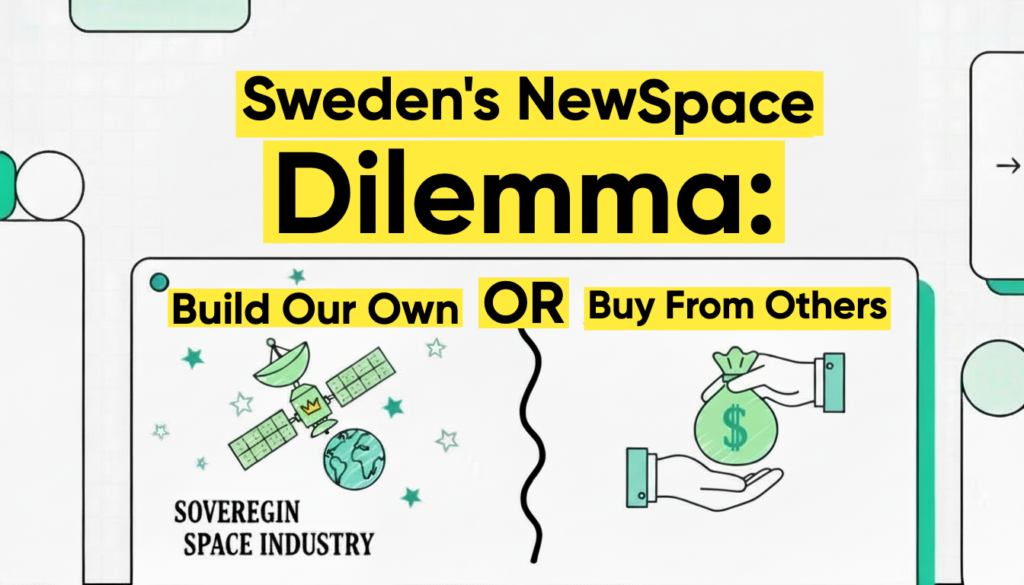
Will Sweden build its own end-to-end domestic services, or continuing buying – and subsequently relying on other countries?
External Resources
A curated selection of relevant articles and publications. Sources will be added continuously.
Historical References / Fact Pieces & Analysis
How governments can move at the speed of startups
This article describes how, in order to enable rapid and revolutionary innovation, government agencies must transform the way in which they interact with industry. Specifically, it explains how NASA leveraged a unique legal/procurement tool to foster the creation of an entirely new space ecosystem – thereby describing the structural changes that are also required in Sweden, to enable the development of a domestic NewSpace ecosystem.

The Center for Growth and Opportunity
Utah State University
Read the full article: English (original)
“…the program demonstrates an alternative approach to procurement that has considerable strengths. In particular, it lets feisty newcomers like SpaceX contribute to government programs while still moving at the speed of startups, not the speed of government. If SpaceX had instead signed on to a cost-plus program […] the company would have faced the same incentive every other contractor does — to slow down — and might have lost its soul.”
Op-Ed / Debate Articles
Sweden’s space challenge requires system change
This article calls the announcement that Sweden will spend billions to purchase foreign-produced satellite capabilities proof of systemic failure, since Sweden’s domestic space industry is — and will remain — unable to meet its own needs until such time that politicians at the national level enable a completely new approach, which intentionally bypasses the existing system.

“Many here seem to have interpreted the news that Sweden will spend 1.3 billion on foreign satellite capabilities as positive. Unfortunately, that is not the case. The fact that these space capabilities have to be purchased from foreign actors is undeniable proof that Sweden has failed.”
Sweden must find its own path to space
This article clearly describes how Sweden must define a unique, purpose-built path into the space economy rather than relying on outdated approaches and the existing models of procurement. The region of West Sweden understands that the time to act is now — and is taking action, rather than waiting for national guidance.
“When Sweden invests billions in satellites and space services, a significantly larger part of the value creation should take place in Sweden. This requires that the public sector dares to take the role of anchor customer […]”